The sticker-price gap between a manufactured home and a comparable stick-built house is enormous. A new single-wide runs $60,000 to $95,000, a new double-wide lands somewhere between $100,000 and $180,000, and a modular home sits in the $150,000 to $300,000 range. The equivalent site-built starter house in most U.S. markets starts around $350,000 and climbs past $600,000 in high-cost areas. On paper the manufactured home wins by a factor of three or four.
Paper isn't the whole story. Chattel loan rates run higher, lot rent can add $350 to $900 a month on top of your loan payment, and site-built homes on owned land have a long track record of appreciation that manufactured homes on rented lots generally don't match. So the honest question isn't "which is cheaper up front" — it's "which actually costs less once you account for rates, ongoing fees, equity, and the time you plan to stay."
Purchase Price: Where Manufactured Homes Win Clearly
The purchase price gap is substantial. According to the U.S. Census Bureau's Manufactured Housing Survey, the average sale price of a new manufactured home (excluding land) was approximately $108,100 in 2024. Site-built homes averaged $404,000+ in the same period.
Breaking it down by home type:
| Home Type | Typical Price Range (2026) |
|---|---|
| New single-wide manufactured home | $60,000–$95,000 |
| New double-wide manufactured home | $100,000–$180,000 |
| New modular home | $150,000–$300,000 |
| New site-built home (U.S. median) | $380,000–$450,000 |
| New site-built home (high-cost market) | $600,000–$1.2M+ |
In terms of square footage, manufactured homes typically deliver livable space at $40–$80/sq ft for basic models vs. $150–$300+/sq ft for site-built construction. That's a compelling value proposition for buyers focused on cost per square foot.
Monthly Payment Comparison
Here's where the advantage narrows — but doesn't disappear. Higher loan rates on manufactured homes offset some of the purchase price savings.
Scenario: $120,000 double-wide manufactured home, 10% down, 20-year chattel loan at 8.5%
Calculate this payment: Monthly P&I ≈ $1,001
Scenario: $380,000 stick-built starter home, 10% down, 30-year mortgage at 7%
Monthly P&I ≈ $2,279
Even with the rate disadvantage, the manufactured home payment is 56% lower. Add lot rent of $500/month to the manufactured home and the total is $1,501/month — still $778 less per month than the site-built mortgage alone.
Over 10 years, that $778 monthly difference compounds to $93,360 — money that could go toward savings, investments, or building equity elsewhere.
The Lot Rent Factor
Lot rent is the swing factor in almost every manufactured home cost comparison. If you're placing the home in a community on leased land, lot rent adds $350–$900/month depending on location, amenities, and community type.
- Rural Midwest communities: $350–$500/month
- Suburban communities with amenities: $500–$750/month
- Coastal/high-cost areas: $800–$1,500+/month
In high-cost coastal markets, lot rent can eat most of the advantage. A $900/month lot rent + $1,000/month loan payment = $1,900/month total — only $379 less than the stick-built mortgage in our example, and with much weaker appreciation potential.
If you own the land, the equation changes significantly. See our lot rent vs. land ownership analysis for a full breakdown of how land ownership changes the math over time.
Appreciation vs. Depreciation
This is where site-built homes have a clear edge, and it's important to be honest about it.
Site-built homes on owned land have historically appreciated roughly 3–5% per year nationally, though with significant regional variation. Over 10 years, a $380,000 home might be worth $530,000–$620,000 — building $150,000–$240,000 in equity beyond your payments.
Manufactured homes have a more complicated appreciation story:
- Homes on leased land typically depreciate, especially older models. The land value isn't yours, and the home itself loses value like a vehicle.
- Homes on owned land, titled as real property, have shown appreciation more in line with site-built homes in many markets — particularly newer, higher-quality homes in desirable areas.
- Land-home packages (manufactured home + owned lot) in suburban areas have appreciated meaningfully in recent years as housing demand has pushed up all home values.
The depreciation/appreciation question is often the decisive factor for buyers trying to choose between manufactured and site-built housing. If building long-term wealth through home equity is a primary goal, owning the land matters enormously.
Total Cost Over 10 Years: A Realistic Model
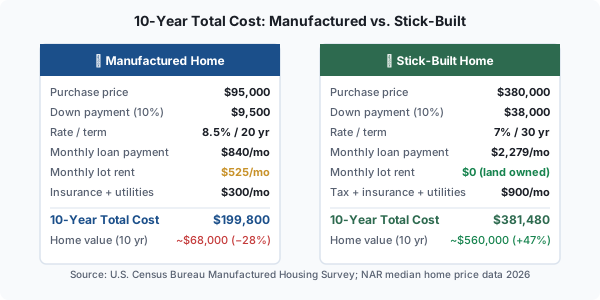
Let's compare two realistic scenarios over 10 years for a family in a mid-size U.S. city:
Scenario A: Manufactured home in a community
- Home: $95,000 double-wide, $9,500 down, 20-year chattel at 8.5%
- Monthly loan payment: $840
- Lot rent: $525/month
- Insurance: $100/month
- Utilities (no land maintenance): $200/month
- Total monthly housing: ~$1,665
- 10-year cost: $199,800
- Home value after 10 years: ~$60,000–$75,000 (depreciation)
- Net cost after assumed equity: ~$130,000–$145,000
Scenario B: Stick-built starter home
- Home: $380,000, $38,000 down, 30-year mortgage at 7%
- Monthly loan payment: $2,279
- Property tax + insurance: $500/month
- Utilities + maintenance: $400/month
- Total monthly housing: ~$3,179
- 10-year cost: $381,480
- Home value after 10 years: ~$520,000 (4% annual appreciation)
- Net cost after equity: ~$75,000–$90,000
The stick-built home costs more monthly and over 10 years, but the equity position is dramatically better. If you have the income to afford the higher payment, the stick-built home may be the better long-term financial choice. If the income isn't there, the manufactured home path is a legitimate way to own housing instead of renting.
Maintenance and Repair Costs
Site-built homes carry higher maintenance costs in absolute terms — they're bigger and have more systems. But manufactured homes have their own maintenance profile:
- Roof: Manufactured home roofs have lower pitch and different materials. Budget $4,000–$8,000 for replacement every 15–20 years.
- Belly board: The insulation wrap under the floor can sag or be damaged by pests or moisture. Repairs run $500–$2,000.
- HVAC: Ductwork runs under the floor and can develop leaks. Annual checks and occasional repairs: $200–$800/year.
- Skirting: Requires regular inspection and occasional panel replacement: $200–$1,000 as needed.
- Foundation/piers: Settling and frost can shift piers. Re-leveling runs $500–$2,000 in most cases.
Budget $1,500–$3,000/year for maintenance on a mid-age manufactured home — less than the conventional wisdom for a site-built home (usually 1–2% of value, or $3,800–$7,600 on a $380,000 house), but still a real ongoing cost.
When Manufactured Wins Clearly
The manufactured home path is clearly better in these situations:
- Your income can't support a conventional mortgage payment
- You're buying in a rural or semi-rural area where site-built homes are reasonably priced but still out of reach
- You're retiring and want to free up capital by downsizing
- You're investing and need cash-flow-positive rental housing at low acquisition cost
- You need housing immediately (new manufactured homes deliver in 2–4 months vs. 8–12 for site-built construction)
When the site-built path wins: you have sufficient income, you're in an appreciating urban/suburban market, you prioritize long-term equity, or you plan to stay in the home for 15+ years.
Use our mobile home loan calculator to model your specific scenarios, then talk to a HUD-approved lender who can walk through both paths with current rate quotes for your credit and income situation.