If you're buying a manufactured home, the land question sits underneath almost every other financial decision. Rent the lot and you keep upfront costs down, but you're stuck with higher-rate chattel loans and a monthly bill that can rise 3% to 8% every year. Own the land and you qualify for real mortgage rates, eliminate the rent increases, and pick up a second asset that can appreciate on its own.
There isn't a universally right answer. There is a right answer for your specific numbers, though, and this guide walks through what those numbers actually look like.
What Is Lot Rent?
When you place a manufactured home in a mobile home community (also called a manufactured home park or land-lease community), you own the home but rent the lot from the community owner. Lot rent is a monthly fee that covers your right to occupy that space.
What lot rent typically includes:
- Water and sewer service (in most communities)
- Trash pickup
- Road maintenance within the community
- Common area upkeep (pool, clubhouse, playground if applicable)
- Access to utilities connections
What's usually NOT included:
- Electric and gas (billed separately)
- Cable/internet
- Property taxes on the home (you pay these; in some states, they're lower for personal property)
Average lot rent by region (2026):
- Rural Midwest and Southeast: $350–$500/month
- Suburban Midwest and Southeast: $475–$650/month
- Suburban West and Northeast: $600–$900/month
- Coastal high-cost areas: $900–$1,500+/month
Lot rent increases annually in most communities — typically 3%–8% per year, following inflation and local market conditions. Unlike your mortgage payment, lot rent isn't fixed.
What Does Land Ownership Mean for a Manufactured Home?
Owning the land under your manufactured home changes everything about the financial picture. When the home is permanently affixed to land you own, it can be classified as real property — which means:
- You're eligible for conventional, FHA, and VA mortgages (not just chattel loans)
- Interest rates drop significantly (see below)
- The home may appreciate like real estate rather than depreciate like personal property
- There's no lot rent — your housing cost is more predictable
- You own an appreciating asset (the land) independent of the home
Land prices for manufactured home placement vary widely:
- Rural land (1/4 to 1 acre): $15,000–$60,000 depending on location
- Suburban parcels (cleared, with utilities): $50,000–$150,000+
- Infill lots in desirable areas: $100,000–$500,000+
Not everyone can afford to buy land, but in rural and semi-rural markets, the gap between lot rent over 10 years and the cost to buy a modest parcel can be surprisingly close.
The Loan Type Impact: This Is Where It Gets Expensive
The biggest financial difference between lot rent and land ownership isn't the lot rent itself — it's the loan type.
On rented land: Chattel loan required. Average rates in 2026 run 7.5%–12%.
On owned land: Real property mortgage available. Average rates in 2026 run 6.5%–8.5%.
On a $100,000 loan at a 20-year term:
| Scenario | Rate | Monthly P&I | Total Interest |
|---|---|---|---|
| Chattel (rented lot) | 9.5% | $932 | $123,700 |
| FHA mortgage (owned land) | 7.25% | $787 | $88,900 |
The rate difference costs $145/month and $34,800 in total interest over 20 years. Add 20 years of lot rent at $600/month = $144,000 in additional housing cost.
Calculate your payment at both scenarios using our mobile home loan calculator — plug in 9.5% for the chattel scenario and 7.25% for the mortgage scenario on your specific loan amount.
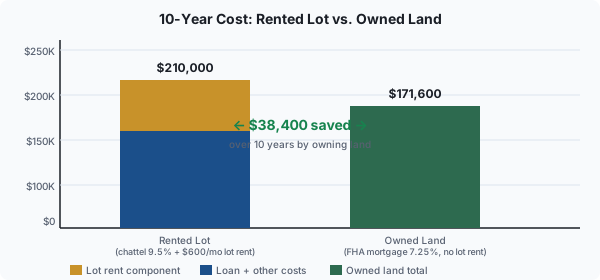
10-Year Total Housing Cost Comparison
Let's run a full 10-year comparison for a $100,000 double-wide in a mid-size U.S. market:
Option A: Home on rented lot
- Down payment: $10,000 (10% on chattel)
- Loan: $90,000 at 9.5%, 20 years → $840/month
- Lot rent: $600/month (averaging 4% annual increase)
- Utilities: $200/month (partial — water/sewer often included)
- Insurance: $80/month
- Average monthly housing cost: ~$1,750
- 10-year total: ~$210,000
- Home value after 10 years: $65,000–$80,000 (some depreciation)
- No land equity; lot lease may be revoked or become unaffordable
Option B: Home on owned land ($45,000 lot)
- Total purchase: $145,000 (home + land)
- Down payment: $14,500 (10%)
- Loan: $130,500 at 7.25%, 20 years → $1,027/month
- Property tax + insurance: $200/month
- Utilities: $200/month
- Average monthly housing cost: ~$1,430
- 10-year total: ~$171,600
- Home value after 10 years: $90,000–$120,000 (modest appreciation on land + home)
- Land equity: $45,000–$65,000
The land ownership path costs $320/month less despite the higher upfront purchase and has significantly better long-term asset value. The upfront cash requirement is higher by $4,500 in down payment — but not dramatically more.
Community Living: The Benefits Worth Considering
Lot rent isn't only a financial negative. Mobile home communities offer real benefits that affect quality of life:
Lower upfront cost and complexity. No land to find, purchase, and prepare. The site is ready — utilities are connected, the lot is leveled, and you can move in weeks after purchase.
Community amenities. Many age-55+ communities and family communities offer pools, clubhouses, social programs, and security features that would cost much more to access independently.
Simplified maintenance. Road maintenance, common area upkeep, and sometimes exterior maintenance are handled by community management.
Social connection. Dense communities — especially retirement communities — provide built-in social networks that matter for quality of life, particularly for older residents.
Lower property taxes. In states where manufactured homes on rented land are classified as personal property, property taxes can be significantly lower than real estate taxes — sometimes $200–$600/year vs. $1,500–$3,500 for equivalent real property.
The Stability Risk of Lot Rent
The main financial risk of lot renting is outside your control: the community owner can sell the property to a developer, raise lot rent dramatically, or decline to renew leases. This is happening more frequently in high-cost markets as land values rise.
Several states have passed protections requiring communities to give residents 6–12 months' notice before closure or major rent increases, and some states require community owners to give residents right of first refusal to purchase the community collectively. But protections vary widely, and manufactured home owners in closing communities often face difficult choices: move an aging home at significant cost, sell at a loss, or abandon the home.
If you choose lot rent, look for:
- Communities with long-term institutional ownership (REITs, established family operations) rather than individual investor-owned
- Lease terms of 3+ years (many leases are month-to-month — push for a longer term)
- Communities with stable rent history (ask for 5 years of rent history)
- States with strong manufactured home resident protections (look up your state's laws)
When Each Option Makes Sense
Lot rent makes sense when:
- You're buying in a market where land is very expensive ($100,000+ per parcel)
- You want lower upfront costs and immediate move-in
- You're buying into a community with strong amenities and stable management
- You prefer managed maintenance and community services
- You're not planning to stay long-term and want flexibility
Land ownership makes sense when:
- Land is reasonably priced relative to your loan amount ($30,000–$60,000 range in many markets)
- You're staying long-term (10+ years)
- You want better financing options and lower rates
- Building long-term equity is important to you
- You want predictable, fixed housing costs
For more on how loan type affects your costs, see our chattel loan vs. mortgage comparison. And run your specific loan scenarios on our calculator — the difference in monthly payment between chattel and mortgage rates is often the deciding factor.