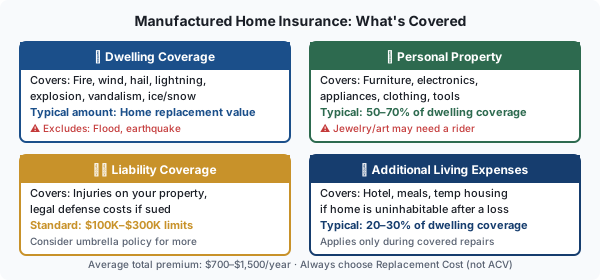
Expect to pay somewhere between $700 and $1,500 a year to insure a manufactured home in 2026, give or take $50 a month depending on where you live, how old the home is, and what level of coverage you choose. Most lenders want proof of insurance before they'll close on your loan, so this is rarely optional — but the coverage decisions you make are going to affect both your annual premium and what happens if you ever need to file a claim.
Manufactured home insurance is its own product, not a regular homeowners policy with a sticker swapped out. Most standard homeowners policies exclude manufactured and mobile homes outright, which is why you need a carrier that specializes in this coverage. The way policies are priced, the types of coverage offered, and the common exclusions all differ from what a site-built homeowner would see.
Here's what you're actually paying for, what drives the premium one way or the other, and the coverage gaps that catch people off guard at claim time.
Average Cost of Mobile Home Insurance
Nationally, manufactured home insurance runs $700–$1,500/year for a full-coverage policy. That breaks down to roughly $58–$125/month.
Factors that push your premium toward the higher end:
- Older home (pre-1990)
- Located in a hurricane, tornado, or hail-prone area
- High-value home ($150,000+)
- Replacement cost coverage (vs. actual cash value)
- Low deductible ($500 or less)
- Poor condition or prior claims history
Factors that push toward the lower end:
- Newer home (post-2000)
- Low-risk climate area
- Lower home value ($60,000–$90,000 range)
- Actual cash value policy
- High deductible ($2,500+)
- Good credit score (many insurers use credit-based insurance scores)
When you use our mobile home loan calculator, you can include annual insurance costs to see how they affect your total monthly housing payment. A $1,200/year policy adds $100/month to your cost.
What Does Mobile Home Insurance Cover?
A standard manufactured home insurance policy is really several coverages bundled together. Here's what the main categories actually do.
Dwelling coverage pays to repair or replace the home itself if it's damaged by a covered peril. The typical covered perils list includes fire, wind, hail, lightning, explosion, vandalism, and the weight of ice or snow on the roof. Flooding and earthquakes are excluded from standard policies and require separate coverage.
Personal property coverage handles your belongings inside the home — furniture, electronics, clothing, appliances — and is usually written at 50% to 70% of your dwelling coverage limit. High-value items like jewelry, art, and firearms often need separate riders with their own limits, so if you have any, flag them to your agent up front.
Liability coverage is there for the day someone is injured on your property and sues you. Standard policy limits run from $100,000 to $300,000. If you own significant assets, look into a separate umbrella policy on top of your homeowners liability.
Additional living expenses (ALE) covers the cost of temporary housing if your home becomes uninhabitable due to a covered loss — hotel rooms, restaurant meals, extra gas because of a longer commute. Most policies cap ALE at 20% to 30% of your dwelling coverage amount.
Trip coverage is specific to manufactured housing. It covers damage that happens while the home is being transported to a new site. Not every policy includes it, so if you're relocating a used home or buying a new one that has to be delivered, ask specifically.
Other structures coverage pays for damage to detached garages, sheds, carports, and fences, and is usually set at 10% to 20% of dwelling coverage.
Replacement Cost vs. Actual Cash Value: The Most Important Decision
This is the single biggest policy difference that most buyers don't understand until they file a claim.
Actual Cash Value (ACV): Pays the current market value of the home at time of loss, minus depreciation. A 15-year-old manufactured home that cost $80,000 new might be worth $45,000 at ACV. If it's destroyed by fire, the payout is $45,000 — even if rebuilding costs $90,000.
Replacement Cost Coverage (RCV): Pays the actual cost to repair or replace the home with like materials and construction, regardless of depreciation. If your $80,000 home now costs $95,000 to replace, RCV pays $95,000 (minus deductible).
RCV policies cost 15–25% more in annual premium — typically $150–$350/year more. It's almost always worth the premium difference. A total loss on an ACV policy can leave you with a payout that covers less than half the cost of replacing the home.
Always buy replacement cost coverage if you can afford the premium.
Specialty Insurers for Manufactured Homes
Not every homeowners insurance company writes manufactured home coverage, and the ones that do aren't always the cheapest option for a given home. A few names come up repeatedly when you start shopping.
Foremost Insurance, part of Farmers Insurance Group, is the largest specialty insurer of manufactured homes in the United States. They write policies in all 50 states and have the deepest manufactured housing expertise of any national carrier, which matters when it comes time to file a claim on a less-common issue.
American Modern Insurance is another national specialty carrier with dedicated manufactured home programs. They tend to be stronger on older homes and less standard situations — older single-wides, homes in coastal areas, homes with past claims — where mainstream insurers might decline coverage.
Assurant partners with a lot of manufactured home lenders and communities and is often the carrier a dealer will quote at the time of purchase. That's convenient, but it's almost never the best price you can get. Treat any dealer-offered policy as a starting point, not a final quote.
Several newer InsurTech companies, including Swyfft, now offer manufactured home coverage in select states and can sometimes beat the incumbents on price. Availability varies a lot by state and by home age, so it's worth checking.
For comparison, also check:
- Allstate (offers manufactured home coverage in most states)
- Nationstar/Mr. Cooper (if they're your lender, may offer insurance)
- Your current auto insurer — bundling sometimes yields 10–15% discount
Don't stop at one quote. Premiums for identical coverage can swing 20% to 40% between carriers, and the only way to find out is to get three or four separate quotes and compare them line by line.
What's Not Covered: Critical Gaps
Flood damage is the most common gap. Standard manufactured home policies exclude flooding entirely. If your home sits inside a FEMA-designated flood zone, your lender will require a separate flood policy through the National Flood Insurance Program, with premiums typically running $700 to $2,000 a year depending on zone and coverage amount.
Earthquake damage is also excluded from standard policies. You can add earthquake coverage in most states for another $100 to $500 a year, and whether that's worth it depends entirely on where you live.
Insurance won't pay for gradual deterioration. Normal wear and tear, rust, rot, and slow settling are treated as maintenance issues, not insured perils, no matter how expensive the repair turns out to be.
If you run a business from home, watch the fine print. Standard policies often exclude business property and business-related liability, so a side hustle or home office with equipment may need a business rider or a separate commercial policy altogether.
Vacant homes create another trap. Most policies reduce or drop coverage entirely if the home sits empty for more than 30 to 60 days. If you're buying a home and won't occupy it right away, tell your insurer up front — they'll usually have a vacant-home endorsement available, but you need to request it.
Pest damage is excluded across the board. Rodents, termites, and other pest damage don't get paid out by virtually any manufactured home insurance policy on the market.
What Lenders Require
Most lenders require:
- Minimum dwelling coverage equal to the loan amount or replacement cost, whichever is less
- Lender listed as mortgagee/loss payee on the policy
- Proof of insurance (declarations page) before closing
- For real property loans: typically $300,000 liability minimum
- For FHA and VA loans: specific coverage requirements per program guidelines
If you don't provide acceptable insurance before closing, the lender may place "force-placed insurance" — a policy they select that meets their requirements. Force-placed insurance is dramatically more expensive ($2,000–$5,000/year) and often provides less coverage. Always secure your own policy first.
How to Lower Your Premium Without Sacrificing Coverage
Raising your deductible is the fastest way to cut your premium. Moving from a $500 deductible to $2,000 can reduce the annual premium by 20% to 30%. The catch is obvious: only do this if you actually have $2,000 in savings you could tap on short notice if you needed to file a claim.
Bundling with your auto insurance is the next easiest move. Most insurers offer multi-policy discounts in the 10% to 15% range when you carry two or more policies with them, and the paperwork is usually trivial to set up.
Safety equipment also drops premiums, though not dramatically. Smoke detectors, fire extinguishers, deadbolt locks, and monitored security systems each knock 2% to 8% off, depending on the carrier and the specific equipment. Stack enough of them together and you can get to meaningful savings.
Newer homes pay less, too. If you're buying a home built after 2000 — and especially one built after 2010 to updated HUD Code standards — you qualify for better rates than an older home would get, independent of everything else on the application.
Credit matters more than people expect. Most insurers use credit-based insurance scores (it's legal in the majority of states), and better credit translates directly to lower premiums. The same steps that help your loan rate also help your insurance premium, so improvements you make before applying for a loan carry over to the insurance quote.
Permanent foundations get better rates than temporary piers. Homes on HUD-compliant permanent foundations are rated as lower-risk properties by most carriers, typically knocking 5% to 10% off the premium.
When budgeting for your manufactured home purchase, include insurance in your monthly cost estimate. Our loan calculator includes a field for annual insurance so you can see the true total monthly payment. A realistic insurance budget of $900–$1,200/year adds $75–$100/month to your housing costs — include it from the start to avoid budget surprises at closing.
For a complete guide to all the costs involved in purchasing a manufactured home, see our step-by-step buying checklist. And for how insurance affects your loan structure and lender requirements, our down payment guide covers what lenders look for at closing.