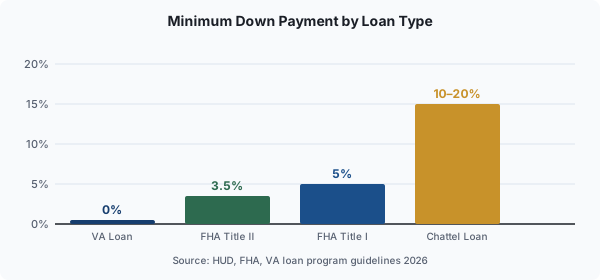
The required down payment on a manufactured home depends almost entirely on which loan program you use. FHA Title II (the real-property mortgage program) needs as little as 3.5% if your credit score is 580 or higher. FHA Title I, which covers the home alone when you're on a rented lot, requires a flat 5%. Most conventional chattel lenders want 10% to 20%, and a few specialty programs for veterans or rural buyers can go all the way down to 0%.
How much you put down matters because it shapes three things at once: whether you qualify, the interest rate you're offered, and the monthly payment you'll be writing a check for every month. Manufactured home financing has its own set of rules here, separate from the conventional single-family mortgage world, and they're worth understanding before you start writing offers.
Down Payment Requirements by Loan Type
FHA Title II (real property mortgage): 3.5%–10%
This is the lowest down payment available for most manufactured home buyers who own their land. With a credit score of 580 or above, you qualify for 3.5% down. Scores between 500 and 579 require 10% down. Below 500, you're not eligible for FHA.
On a $120,000 home, 3.5% down is $4,200. That's a realistic number for many buyers who've been saving while renting.
FHA Title I (personal property loan): 5%
FHA Title I requires a minimum 5% down payment regardless of credit score. On a single-wide home priced at $55,000, that's $2,750. FHA Title I has hard loan limits ($69,678 for a single-section home as of 2026), so this program primarily serves the lower end of the market.
Conventional chattel loans: 10%–20%
Most specialty chattel lenders — 21st Mortgage, Cascade Financial, Triad Financial — advertise 5% down but in practice require 10–20% for most borrowers. A borrower with 720+ credit and stable income might get approved at 10%; someone with a 660 score is more likely to need 15–20%.
VA loans: 0% down
Veterans, active-duty service members, and surviving spouses may qualify for a VA-guaranteed manufactured home loan with no down payment. The home must meet VA property standards and be classified as real property (land + home). This is the single best down payment option in manufactured home financing.
USDA loans: 0% down in eligible rural areas
USDA Single Family Housing Guaranteed Loans cover manufactured homes in eligible rural and semi-rural areas. Zero down payment is available for qualifying income levels. Check the USDA property eligibility map to see if your target location qualifies.
How Down Payment Affects Your Monthly Payment
Let's say you're buying an $85,000 single-wide home with a 20-year chattel loan at 9% interest. Here's what different down payment amounts do to your monthly cost:
| Down Payment | % Down | Loan Amount | Monthly P&I | Total Interest |
|---|---|---|---|---|
| $4,250 | 5% | $80,750 | $727 | $93,900 |
| $8,500 | 10% | $76,500 | $689 | $88,900 |
| $12,750 | 15% | $72,250 | $651 | $83,900 |
| $17,000 | 20% | $68,000 | $612 | $79,000 |
Going from 5% to 20% down saves you $115/month and about $14,900 in total interest over the loan. That's meaningful — but you also had to put in an extra $12,750 upfront. The right amount depends on what your savings situation looks like and whether that cash earns more sitting in an investment account.
Use our mobile home loan calculator to model different down payment scenarios — plug in various down payment amounts and see exactly how monthly cost and total interest change.
Does a Larger Down Payment Get You a Better Rate?
Sometimes — but it depends on the lender and loan type.
For chattel loans, crossing certain LTV (loan-to-value) thresholds can move you to a better rate tier. Going from 90% LTV (10% down) to 80% LTV (20% down) may save 0.25%–0.5% on your rate, in addition to the lower balance.
For FHA loans, the down payment affects which program applies (3.5% vs. 10%) but not the rate — FHA rates are set by the broader mortgage market and your credit score, not your LTV.
For VA loans, there's no down payment requirement at all, and no rate penalty for putting $0 down. VA-guaranteed rates are already competitive, and the VA funding fee can be rolled into the loan.
Where Do Buyers Come Up With the Down Payment?
Personal savings are the most common source. Manufactured homes are typically more affordable than site-built homes, so buyers who've been priced out of conventional homeownership often have several months or years of savings built up.
Down payment assistance programs (DPA). Many states have DPA programs that work with FHA loans, including some that cover manufactured homes. HUD maintains a resource listing by state for first-time homebuyer programs. These vary widely — some are forgivable grants; others are soft second mortgages.
Gift funds. FHA allows down payment funds to be gifted from a family member. The gift must be documented with a letter stating no repayment is required. Most chattel lenders also accept gifts, but requirements vary by lender.
Sale of assets. Proceeds from selling a car, boat, recreational vehicle, or other property can be used for a down payment if properly documented.
Retirement account withdrawals. First-time homebuyers can withdraw up to $10,000 from an IRA without the 10% early withdrawal penalty (income tax still applies). This is an option of last resort — the tax hit and lost compounding can be significant.
The Trade-Off: Down Payment vs. Keeping Cash Reserves
One mistake buyers make is draining their savings to maximize the down payment, leaving themselves with no cash buffer. Lenders look at this too — some chattel lenders want to see 2–3 months of payments in reserves after closing.
If putting 20% down leaves you with $500 in the bank, consider putting 15% down instead and keeping the extra $5,000 as an emergency fund. Manufactured homes, like all homes, require ongoing maintenance and repairs. A sudden roof repair or HVAC replacement can easily run $3,000–$8,000.
The right down payment balances: meeting lender requirements, getting a competitive rate, and keeping enough cash on hand to handle homeownership costs. See our full mobile home buying checklist for how down payment fits into the overall purchase process.
Minimum Down Payment Checklist by Situation
- Veteran or active duty: Pursue VA loan → 0% down possible
- Rural/semi-rural location: Check USDA eligibility → 0% down possible
- Own (or buying) the land, 580+ credit: FHA Title II → 3.5% minimum
- Renting the lot, need FHA backing: FHA Title I → 5% minimum, max loan $69,678
- Renting the lot, non-FHA: Chattel loan → plan for 10–20% down
- Credit below 580: Build credit first; chattel lenders at 640+ get meaningfully better terms
Once you know your down payment amount, run the full loan calculation to confirm your monthly payment. Then compare that number against your monthly budget — most lenders want your total housing costs to stay below 35–43% of gross monthly income.