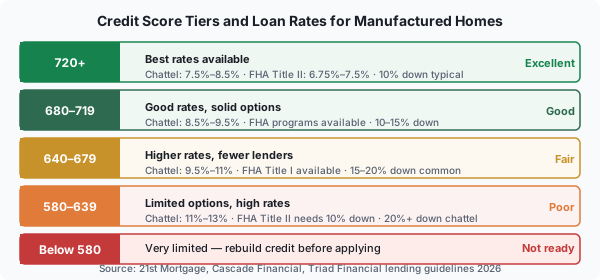
Credit scores carry more weight in manufactured home lending than they do in the regular mortgage market. A 620 score can get someone into a conventional mortgage at close to the going rate, but the same borrower trying to finance a manufactured home will often see quotes a full two percentage points higher than a 720 applicant would. The tiers are tighter, the penalties for low scores are steeper, and the gap between tiers shows up in every monthly payment for the next 20 years.
The short version: FHA Title II needs a 580 minimum for the 3.5% down payment option. FHA Title I also wants 580 or higher at most lenders, though the program itself leaves the minimum up to the individual lender. Most conventional chattel lenders ask for 640 before they'll quote a competitive rate. If your score is below 640 and you have any flexibility on timing, spending 60 to 90 days improving it before you apply usually pays back many times over.
Credit Score Requirements by Loan Program
For an FHA Title II mortgage, the published minimums are straightforward. A 580 score gets you the 3.5% down option. Scores between 500 and 579 require a full 10% down. Anything below 500 disqualifies you from FHA entirely. Of the mortgage programs available to manufactured home buyers who own their land, Title II is the most accessible, although a 580 score will still get you a noticeably higher rate than a 700-plus borrower would see.
FHA Title I is stricter in practice than on paper. The program itself doesn't set a hard minimum — that decision is left to the individual lender — but most Title I lenders want to see 580 to 600 before they'll approve a loan, and 640 or higher before they'll quote a rate that's competitive with what the chattel market is offering.
VA loans are another story. The Department of Veterans Affairs doesn't publish a minimum credit score at all, but most VA-approved lenders settle somewhere around 580 to 620 as their floor. Because the VA guarantee cuts the lender's risk exposure considerably, even a 580 score can qualify for a genuinely competitive rate under this program, assuming you're eligible.
Conventional chattel loans are where credit scores do the most damage to your rate. Here's roughly what to expect by tier:
| Credit score | Likely rate | Typical down payment |
|---|---|---|
| 720 and up | 7.5% to 8.5% | 10% acceptable |
| 680 to 719 | 8.5% to 9.5% | 10% to 15% |
| 640 to 679 | 9.5% to 11% | 15% to 20% |
| 600 to 639 | Higher rates, fewer lenders | 20% or more |
| Below 600 | Very limited options at 12% plus | Rebuilding credit first usually makes more sense |
Specialty chattel lenders like 21st Mortgage Corporation, Cascade Financial Services, and Triad Financial Services each run their own overlays on top of these tiers. The advertised minimums aren't always what borrowers actually qualify for. Plan on the practical approval thresholds being a tier stricter than what the marketing pages suggest.
How Credit Score Affects Your Rate (Real Numbers)
On a $90,000 chattel loan at a 20-year term, here's what credit score tiers typically mean:
| Credit Score | Approximate Rate | Monthly P&I | Total Interest |
|---|---|---|---|
| 720+ | 7.75% | $738 | $87,100 |
| 680–719 | 9.00% | $809 | $104,100 |
| 640–679 | 10.5% | $896 | $124,900 |
| 600–639 | 12.0% | $989 | $147,300 |
The difference between a 640 and 720 score costs $158/month and $37,800 in total interest. Taking 90 days to raise your score from 640 to 720 before applying could be the most financially valuable time you spend in this process.
Use our mobile home loan calculator to see the payment difference at various interest rates on your specific loan amount.
What's in a Credit Score (For Manufactured Home Buyers)
Lenders typically use FICO scores, which weight five factors:
- Payment history (35%): Have you paid all accounts on time? Even one 30-day late payment in the past 24 months can knock 40–80 points off your score.
- Credit utilization (30%): How much of your revolving credit limit are you using? Keeping utilization below 30% is good; below 10% is excellent. Paying down credit card balances is the fastest way to improve your score.
- Length of credit history (15%): How long have your accounts been open? Longer is better. Don't close old accounts, even if you're not using them.
- Credit mix (10%): Having a mix of revolving (credit cards) and installment (auto loan, student loan) accounts helps. A manufactured home loan itself is an installment account.
- New inquiries (10%): Each hard credit pull for a new application drops your score a few points and stays on your report for two years. Don't apply for new credit in the 60–90 days before applying for a manufactured home loan.
How to Improve Your Score Before Applying
Paying down revolving balances is the fastest thing you can do to move your score. If you're sitting at 80% utilization on your credit cards and you can get that down to 30%, the jump often shows up within 30 to 45 days, as soon as the next statement cycle reports to the bureaus. Thirty to sixty points is a reasonable expectation for a meaningful paydown, and it's the single change that pays back fastest.
Pull your free credit reports from all three bureaus at annualcreditreport.com and read them carefully. Look for accounts you don't recognize, balances that don't match what you actually owe, duplicate entries, and late payments that were reported in error. Dispute anything wrong in writing through each bureau's online process. By law, the bureaus have 30 days to investigate and respond.
Don't close old credit card accounts, even ones you haven't used in years. That unused card is still contributing to your length of credit history and keeping your total available credit high, which keeps your utilization ratio low. Closing it chips away at both of those factors at the same time.
If you have a family member with a long-standing credit card in good standing, ask whether they'd add you as an authorized user. Many card issuers report authorized-user activity to the bureaus, and that account's history can show up on your report and pull your score up.
Set up autopay for at least the minimum payment on every account you have. One missed payment can drop your score 40 to 100 points depending on where you're starting from, and the recovery takes years. Pay more manually when you can, but the autopay safety net matters more than people think.
Time helps too, though slowly. Late payments stay on your credit report for seven years, but their weight on your score fades after the first two. A late payment from four years ago does far less damage than one from six months ago. If you had a rough patch a few years back and your recent history is clean, that's already showing up in your current score.
The Strategic Timeline: When to Apply
If your score is below 640 today, here's a realistic improvement timeline:
Month 1: Pull credit reports, dispute any errors, assess utilization on all revolving accounts.
Month 2: Pay down balances (targeting below 30% utilization on each card). Cancel any pending credit applications. Let the balance paydown report to bureaus (takes 30–45 days after statement closes).
Month 3: Check your score again. If you've hit 640–660, you can start shopping lenders. If below, continue paying down balances and wait for late payments to age.
Month 4–6: If you had late payments in the last 12 months, the score improvement curve is slower. Focus on having 6+ consecutive months of on-time payments. Reach out to the creditor about goodwill deletion (sometimes works for long-standing accounts with isolated late payments).
Most buyers who take 90 days to actively improve their credit before applying see score improvements of 30–80 points — and rate improvements that pay off the delay many times over. Calculate what a better rate means for your specific loan amount to understand what the improvement is worth in dollars.
What If Your Score Isn't There Yet?
A co-borrower is worth considering if your score is in the 580 to 620 range and you have a close family member with 680 or higher credit. Lenders often price the loan off the stronger applicant's score, which can drop your rate significantly. Both names go on the loan and both parties are responsible for the debt, so it's a serious ask — but for parents helping adult children buy a first home, it can be the difference between qualifying and not.
Lease-to-own and rent-to-own arrangements are another path. Some manufactured home dealers and community owners offer these, letting you move in now, lock in a purchase price, and build credit over a year or two before you convert to a standard loan. Read the contract carefully; the terms vary a lot and some are better deals than others.
HUD-approved housing counselors can also help. HUD funds a nationwide network of counselors who'll walk you through credit improvement strategies, explain which loan programs fit your situation, and point you at down payment assistance you might qualify for. The service is free or very low cost, and you can find a counselor through hud.gov.
One last thing worth saying: even at 640 with a 9.5% or 10% chattel loan rate, the monthly payment on a $75,000 to $90,000 manufactured home often still beats what renters pay in the same market. Don't let a middling credit score talk you out of running the actual numbers for your area. Run the numbers on a realistic loan amount and compare against what you're paying in rent today.
For a full view of the manufactured home buying process — from credit to closing — see our step-by-step buying checklist.