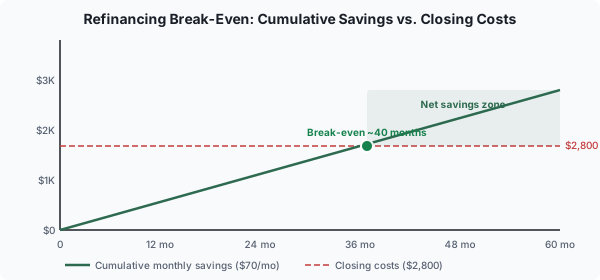
There are three common reasons to refinance a manufactured home loan: rates have dropped at least a point below what you're paying now, your credit score has improved enough to move you into a better tier, or you can finally convert a chattel loan into a real property mortgage because you bought the land. Any of those can save real money. Most refinances break even on their closing costs somewhere between 18 and 36 months, so the decision usually hinges on whether you plan to stay in the home long enough to come out ahead.
The mechanics differ from refinancing a regular mortgage, though. Your options depend on whether your home is personal or real property, the closing costs are structured differently, and a few specific refinance types exist only for manufactured housing. Walk into this without a plan and the closing fees can eat most of your monthly savings before you ever see them.
When Refinancing Makes Sense
A one-point drop in rates is usually the minimum worth acting on. On a $90,000 loan, cutting your rate by 1% saves roughly $60 to $70 a month. If the refinance costs $2,500 to close, you break even in about 36 months. Below a one-point drop, the savings rarely justify the closing costs unless you're confident you'll be in the home for many more years.
A major credit score improvement can also open the door. If you originally financed with a 640 score and you've worked your way up to 720 since then, you may qualify for a rate 1.5 to 2.5 points lower than what you're currently paying. Our rate guide shows how much credit score affects manufactured home loan pricing; the gap between a 650 and 720 borrower often runs $80 to $120 a month on a mid-sized loan.
The highest-impact refinance available to manufactured home owners is converting a chattel loan to a real property mortgage. If you own the land your home sits on — or you can buy it — moving from chattel to an FHA Title II or conventional mortgage can knock 2 to 4 percentage points off your rate. On a $100,000 loan, that works out to $120 to $200 a month saved on interest alone. The process is more involved than a simple rate-and-term refi, but the savings are usually worth the work.
Cash-out refinances are another option, though they only make sense if your home has actually appreciated in value, which is more common with land-owned real property homes than with homes on rented lots. Lenders will generally allow up to 80% loan-to-value on a cash-out refinance for manufactured housing, though some cap chattel properties at 75%.
Shortening your term is the last category worth looking at. If rates have moved even a little in your favor and you can afford a slightly higher payment, refinancing a 20-year chattel loan into a 15-year loan at a better rate saves a surprising amount of total interest while also building equity faster. Use our loan calculator to compare your current balance and remaining term against a shorter-term refinance before deciding.
Types of Manufactured Home Refinances
Rate-and-term refinance: Replace your existing loan with a new one at a lower rate and/or different term. No cash comes out. This is the most common refinance type.
Cash-out refinance: Borrow more than your current balance, taking the difference in cash. Available on real property mortgages; harder to find for chattel loans. Lenders typically require 20% equity minimum.
Chattel-to-mortgage conversion (term: land-home package refinance): Convert personal property loan to a real property mortgage. Requires that you own the land and that the home be permanently affixed to a HUD-compliant foundation. This is a more involved process but often the most financially impactful refinance available.
FHA Streamline (for existing FHA loans): If you currently have an FHA manufactured home loan, you may qualify for an FHA Streamline refinance — a simplified process with no appraisal required, minimal documentation, and faster closing. Must provide a net tangible benefit (lower payment or shorter term).
The Break-Even Calculation
Before refinancing, calculate your break-even point:
- Determine your new monthly payment using our loan calculator with the new rate and remaining term
- Subtract it from your current payment → this is your monthly savings
- Divide total closing costs by monthly savings → this is your break-even in months
Example: Current payment $720/month. New payment $650/month. Monthly savings: $70. Closing costs: $2,800. Break-even: 2,800 ÷ 70 = 40 months (3.3 years).
If you plan to stay in the home at least that long, refinancing makes financial sense. If you're likely to move or sell within two years, it probably doesn't.
The Chattel-to-Mortgage Conversion Process
This type of refinance has extra steps because you're legally changing what kind of asset the home is. Expect the process to take 60 to 120 days from start to finish, and plan for it in five phases.
First, confirm that you own the land outright or that the land is part of the transaction you're closing on. If you currently rent your lot, you'd need to buy it before any of this applies. Some manufactured home communities do sell individual lots to residents, although most don't.
Second, get a permanent foundation inspection. Hire an engineer or a certified inspector who can confirm that your home's foundation meets HUD's Permanent Foundation Guide for Manufactured Housing. This inspection runs $300 to $600 and you'll need the certification for the refinance paperwork.
Third, retire the vehicle title. A title company or real estate attorney handles this. They surrender the home's vehicle title to your state's DMV and record a deed for the combined land-plus-home parcel. The process takes two to six weeks and runs $500 to $1,500 in title and recording fees.
Fourth, apply for a real property mortgage. Now that the home qualifies as real estate, you can apply for FHA Title II, VA (if eligible), or a conventional loan. The lender will order an appraisal, and the appraiser has to be familiar with HUD's manufactured housing appraisal guidelines, which is worth confirming up front.
Finally, close the new loan. The refinance mortgage pays off your existing chattel loan in full. Total closing costs for a real property refinance typically run $3,000 to $6,000, which is more than a plain chattel refinance would cost, but the rate savings usually cover that differential within two or three years.
What Lenders Look for in a Manufactured Home Refinance
Equity is the first thing most lenders check. They want to see that your home is worth meaningfully more than you owe — at least 10% to 20% in most cases. For chattel loans this is trickier than it sounds, because manufactured homes on rented lots don't always get formal appraisals. Lenders fall back on NADA Guides or recent comparable sales in the area to establish value.
Credit score requirements are the same as they were for your original purchase: 580 or higher for FHA, 640 or higher for most chattel refinancers. If your score has improved since you first bought the home, you'll see the benefit in the rate you're quoted.
Income matters too. Two years of consistent employment or self-employment income is the baseline most lenders want to see. Self-employed borrowers will usually need to provide two years of tax returns to document income stability.
Home condition is the last piece. Underwriters and appraisers look at the physical state of the home. Deferred maintenance, visible roof damage, or foundation issues can derail a refinance approval or force you to complete repairs before closing. If your home has issues, plan to address them before you apply.
Costs to Expect
Closing costs vary significantly by refinance type. A straightforward chattel refinance typically runs $1,500 to $3,500 in total fees. Some lenders offer "no-closing-cost" refinances where the fees are rolled into a slightly higher rate — you pay more over time but nothing comes out of pocket at closing.
A real property mortgage refinance is more expensive, usually $3,000 to $7,000 all-in, including lender fees, title insurance, appraisal, and recording fees. More complex files cost more. A chattel-to-mortgage conversion adds another $1,500 to $3,000 on top of that for the foundation inspection and title conversion work.
Common Refinancing Mistakes
The biggest mistake is refinancing too soon after an earlier refinance. If you refinanced within the last 12 to 24 months, you likely reset your amortization schedule and your recent payments have been mostly interest anyway. Refinancing again restarts that clock, and the early payments on the new loan will once again be weighted heavily toward interest. Unless the rate change is substantial, wait.
A related trap is focusing only on the new monthly payment. A lower payment looks good, but if you extend your term significantly to get there, you can easily end up paying more total interest than if you'd just kept the original loan. Run the math on total interest remaining — our loan calculator handles this comparison — before committing to a longer term just to shave the payment down.
Don't skip shopping multiple lenders, either. Chattel refinance rates vary significantly between specialty lenders, and the difference between the best and worst quote for the same borrower can be over a full percentage point. Three quotes is the minimum for a meaningful comparison; four or five is better.
And finally: if you're on the fence and rates have recently dropped, waiting usually costs you. Rate windows for manufactured home financing don't stay open forever. Once rates climb back, the opportunity may not return for another cycle.
For a complete view of your manufactured home finances, run the numbers on our calculator with your current loan details — it shows total interest remaining, which helps you decide if refinancing makes sense right now.