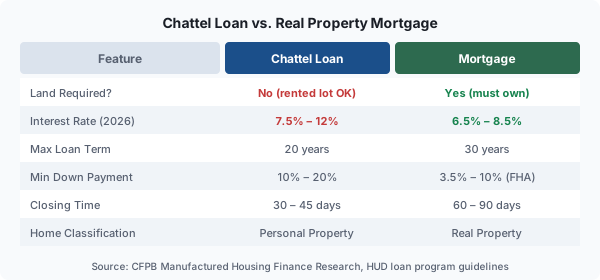
When you finance a manufactured home, the loan type almost always comes down to a single question: do you own the land under it? Rent the lot and you're stuck with a chattel loan, which treats the home as personal property the same way a lender treats a car or boat. Buy the land and the home can be reclassified as real property, which opens the door to a regular mortgage.
The naming is boring. The difference in what you actually pay is not. Chattel loans and real property mortgages are separate financial products with separate underwriting, separate rate tables, separate term limits, and separate total costs over the life of the loan. Picking the wrong one — or assuming you have no choice — can cost you tens of thousands of dollars.
The Core Difference: Land Ownership
A chattel loan treats the manufactured home as personal property — like a car or boat. The home can be moved; it's not permanently attached to land you own. This is the default for homes in mobile home parks and communities where you rent the lot.
A real property mortgage treats the home like a conventional house. It requires that the home be permanently affixed to a foundation on land you own, and that the vehicle title be retired (converted to real estate). Once that happens, standard mortgage financing applies.
The reason this matters: lenders charge more for chattel loans because their collateral (a depreciable, moveable asset) is riskier than real estate. That difference shows up in your rate, your term, and your monthly payment.
Rates: The Biggest Practical Difference
Chattel loans in 2026 run approximately 7.5%–12% for borrowers with decent credit. Real property mortgages on manufactured homes run 6.5%–8.5%, depending on whether they're FHA, VA, or conventional.
The impact on total cost is significant. Let's look at a $100,000 home with 10% down — a $90,000 loan:
| Loan Type | Rate | Term | Monthly Payment | Total Interest |
|---|---|---|---|---|
| Chattel loan | 9.5% | 20 years | $840 | $111,500 |
| FHA Title II mortgage | 7.25% | 20 years | $710 | $80,400 |
| FHA Title II mortgage | 7.25% | 30 years | $614 | $121,200 |
A 30-year mortgage has lower monthly payments than a chattel loan but costs more in total interest than a 20-year mortgage. Most buyers financing a manufactured home as real property benefit most from a 20-year term if they can handle the payment.
Run your own numbers with our mobile home loan calculator — try both rates and see which scenario fits your budget.
Chattel Loan Pros and Cons
Advantages:
- Faster closing (typically 30–45 days vs. 60–90 for a mortgage)
- Works when you're renting a lot — no land required
- Less paperwork; simpler process than mortgage underwriting
- Easier to qualify for if your credit isn't perfect
- Some specialty lenders close in under three weeks
Disadvantages:
- Higher interest rates (1.5–4 points more than mortgages)
- Shorter maximum terms (20 years for most chattel lenders)
- No 30-year option; higher required monthly payments
- Home may depreciate in value, especially on rented land
- No ability to take advantage of mortgage interest deduction if loan is small enough that standard deduction is better
The Consumer Financial Protection Bureau's manufactured housing research found that chattel borrowers pay significantly more over the life of their loans than similarly situated real property mortgage borrowers. The CFPB has pushed for policy changes to increase access to mortgage financing for manufactured home buyers — but as of 2026, chattel loans still represent the majority of manufactured home financing.
Real Property Mortgage Pros and Cons
Advantages:
- Lower interest rates
- Longer terms available (up to 30 years with FHA/VA)
- Home treated as real estate — potential for appreciation
- Access to FHA, VA, and USDA programs
- Mortgage interest deductible on federal taxes (for itemizers)
- Better consumer protections under RESPA and TILA
Disadvantages:
- Requires land ownership — you have to own the lot
- Must permanently affix the home to a foundation (HUD-compliant)
- Must retire the vehicle title before closing
- Longer, more complex closing process
- Stricter property standards and inspections
- Home must be built after 1976 (HUD Code compliance required)
Converting from Chattel to Real Property
If you currently have a chattel loan and you own (or plan to buy) the land, you can convert your home to real property and refinance into a mortgage. The process involves:
- Filing a permanent foundation certification (an engineer or licensed inspector verifies the home meets HUD permanent foundation guidelines)
- Retiring the vehicle title with your state's DMV
- Recording a deed for the property (home + land together)
- Refinancing the chattel loan into a real property mortgage
This process takes 30–90 days and costs $1,500–$4,000 in fees (foundation inspection, title work, recording fees). But if the rate difference saves you $150/month in interest, you'll recoup those costs within two to three years. Our refinancing guide covers this scenario in detail.
Which Loan Type Applies to You?
Work through these questions:
Do you own or plan to own the land?
- Yes → Pursue a real property mortgage (FHA Title II, VA, or conventional)
- No → Chattel loan is your primary option (though some lenders offer land-home packages)
Is the home on a permanent foundation or can it be made permanent?
- Already permanent → Can proceed with real property mortgage process
- Not yet → Must complete foundation work before applying for a mortgage
What's your timeline?
- Need to close in under 45 days → Chattel loan is faster
- Can wait 60–90 days → Mortgage may be worth the wait for a lower rate
What's your credit score?
- 580+ → FHA Title II available; VA if eligible
- 640–720 → Chattel loan at mid-range rates; compare with FHA
- 720+ → Both options are viable; run the numbers to compare total cost
Estimate your monthly payment at different loan types — plug in 9% for a chattel comparison and 7% for a mortgage comparison to see the real dollar difference on your specific loan amount.
A Note on FHA Title I vs. Title II
FHA has two programs for manufactured housing that don't require land ownership:
- FHA Title I covers chattel loans for the home only (no land required)
- FHA Title II covers real property mortgages (land required)
Title I rates are better than uninsured chattel loans but still higher than Title II mortgages. If you're renting a lot but want FHA backing, Title I is an option — though it caps loan amounts at $69,678 for a single unit. Our FHA loan comparison article goes deeper on both programs.
Put simply: if land ownership is feasible for you, the math almost always favors a real property mortgage. If you're renting a lot and that's not changing, focus on getting the best chattel loan you can — improve your credit, save for a larger down payment, and collect quotes from three or more specialty lenders before committing.